A website launch checklist is a decision record for taking a site live: what must work, who verifies it, what proves it passed, and who can stop the release. This version is for the client commissioning the work. It connects the build team's technical evidence to the client's business decision rather than repeating a development testing manual.
If you are selecting a delivery partner, our directory of web design partners for technology businesses can help frame that search. Once a partner is appointed, this checklist makes launch responsibility explicit. Adapt the suggested schedule to the site's risk, integrations and the availability of the people who can fix a problem.
The practical question is not whether someone clicked through the site. It is whether the agreed release can safely serve real visitors, whether exceptions have been accepted knowingly, and whether the team can recover if a critical path fails.
Set the Boundary: Launch Authorization Is Not Contractual Acceptance
Use this checklist as the final operational gate, not a substitute for the project stages and review process. Bring the completed review reports into the launch record; do not restart every design and QA phase at the go/no-go meeting.
Practical launch authorization means a named client decision-maker permits this specific release to serve visitors, subject to recorded exceptions. Contractual acceptance, payment triggers and warranty obligations depend on the agreement. Keep those decisions in the statement of work and acceptance framework, not in an improvised launch checklist. Permission to deploy should not silently certify that every contractual deliverable is accepted.
When discussing responsibilities with teams from our web design agency directory, ask who provides the evidence, who authorizes exposure to visitors, and who remains available afterward. These can be different people. Write down the distinction before choosing the launch window.
Build One Launch Record With Named Owners and Evidence
Create one shared record for the release. Each check needs: check ID; requirement; one named accountable owner; verifier if different; evidence link and test time; pass, fail or pending; related ticket; and retest result. Use actual names, not just “client,” “agency” or “both.” Contributors can be listed separately.
For example, “lead form works” is incomplete. A usable entry reads: “Demo request reaches the correct CRM queue; owner: [sales operations person's name]; evidence: synthetic submission ID, matching CRM record and routing confirmation; tested: [time and environment].” Do not place real customer data or credentials in a broadly shared log. Redact screenshots and use approved test identities.
The role labels below indicate which person to nominate. Replace every bracketed role with a name before the gate. No check passes merely because its owner says it is probably fine. Missing evidence remains pending until the client decision-maker explicitly resolves it.
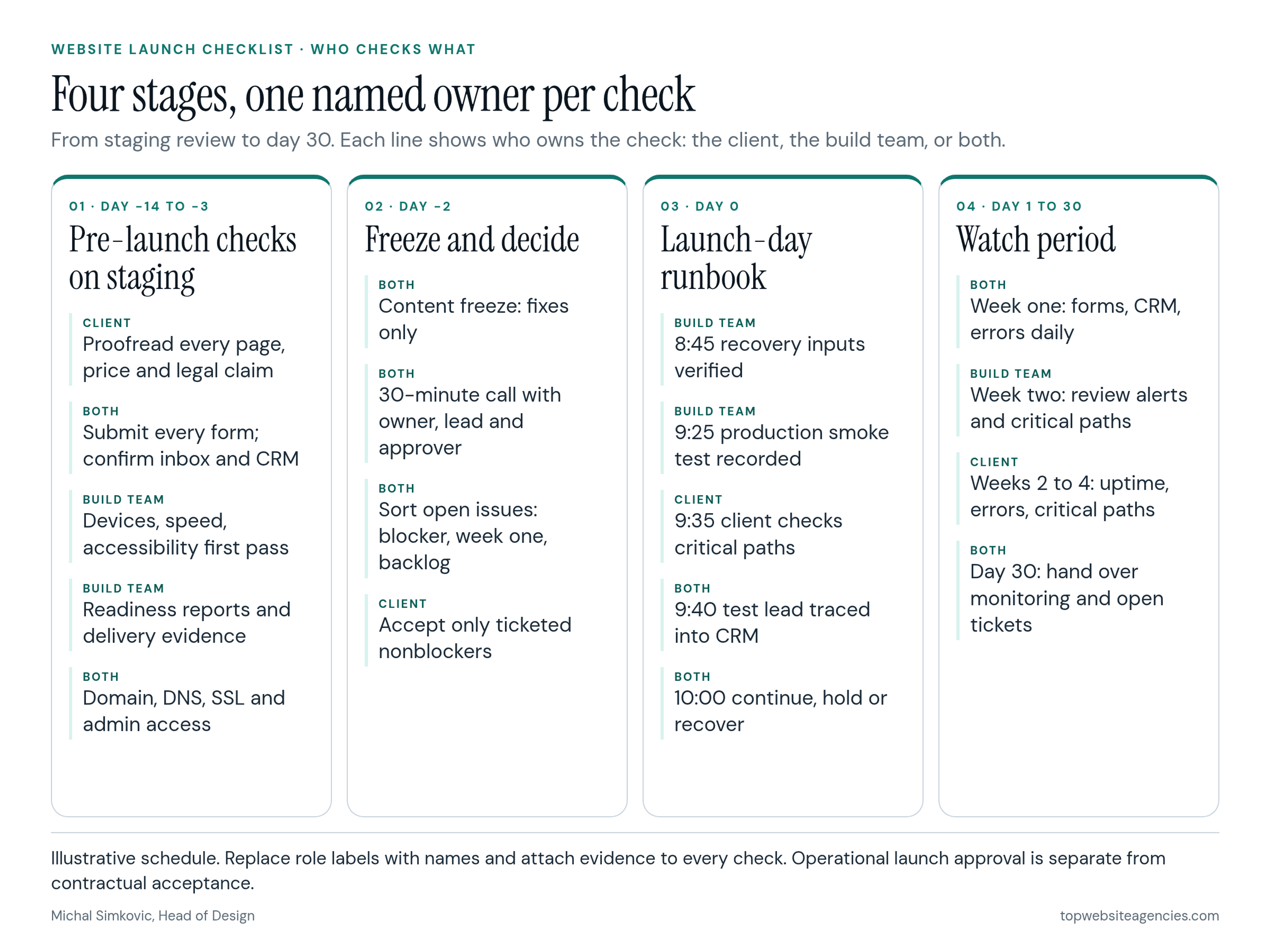
Before Cutover: A Client-Side Readiness Checklist
Schedule this review early enough to investigate failures and retest changed paths. Two weeks before launch can be a planning starting point, not a universal minimum. Complex integrations or a short review window may require a different schedule. Import the build team's existing test results and examine their scope and remaining exceptions.
Content, policy and the approved release
- Content accuracy — owner: [client content lead]. Evidence of pass: approved page inventory with reviewer names and revision, including prices, contact information, footer text, confirmation messages and public claims. Record which revision is approved; later edits require targeted rechecks.
- Privacy and permissions — owner: [client privacy or legal lead]. Evidence of pass: recorded approval of the actual data collection and consent behavior, plus the relevant media-use permissions. Escalate unresolved obligations to the qualified adviser rather than treating a generic checklist as legal clearance.
- Release identity and freeze — owner: [client release coordinator]. Evidence of pass: agreed build identifier, content revision, freeze time and exception log. Define who can admit an urgent change and which checks must be rerun afterward.
Lead delivery, transactions and critical paths
- Form-to-CRM delivery — owner: [sales operations lead]. Evidence of pass: an approved synthetic submission for each distinct form route, matching record in the intended CRM queue, notification receipt and verified field mapping. A success message alone is insufficient. Assign an owner to any delayed integration queue as well.
- Business-critical paths — owner: [client product or marketing lead]. Evidence of pass: dated completion record for the agreed journeys, such as booking a demo, subscribing or completing a purchase, including the confirmation seen by the visitor. Use the platform's approved test mode where available; any live transaction needs separate authorization and a reconciliation plan.
- Tracking and consent — owner: [client analytics lead]. Evidence of pass: an agreed event received for the test journey, checked for unintended duplication and consistency with the approved consent behavior. Treat analytics evidence as separate from proof that a lead reached sales.
Technical readiness summarized for a launch decision
- Device and accessibility readiness — owner: [build-team QA lead]. Evidence of pass: sign-off report identifying the supported device/browser scope, critical-path results and unresolved accessibility findings. The client owner reviews exceptions against the agreed requirements; this gate is not a claim of universal accessibility compliance.
- Performance and availability readiness — owner: [technical lead]. Evidence of pass: release-specific results against agreed project thresholds, plus confirmation that production health checks are configured. State whether performance results are laboratory measurements or observations from real traffic; do not present one as the other.
- SEO readiness — owner: [SEO lead]. Evidence of pass: dated approval of the separate migration or search-readiness plan, with outstanding launch-critical exceptions identified. Use the redesign SEO migration guide for that specialist work. This is a readiness checkpoint, not a second migration tutorial.
- Production access and domain control — owner: [client IT lead]. Evidence of pass: company-controlled access confirmed for the required hosting, domain, CMS and integration accounts, with the assigned operator able to perform the planned change. Record access confirmation, not passwords, in the checklist.
- Recovery readiness — owner: [deployment lead]. Evidence of pass: recoverable release or backup identified, recovery procedure checked in the relevant environment, data-handling assumptions documented, and the authorized recovery operator available for the launch window.
Separate Blockers From Ticketed Nonblockers
Agree the blocker definition before the meeting. A blocker is a failure against a launch-critical requirement, not simply an issue someone dislikes. Candidate blockers include a missing critical lead route, failed checkout, unresolved security exposure or a recovery path that cannot support the proposed cutover. The requirement and risk determine the classification.
A nonblocker must be bounded and understood. “Minor mobile issue” is not enough: record the affected page, device and user task, the workaround, the ticket, a named owner, a due date and the person accepting the residual risk. Do not downgrade an accessibility or legal concern merely because it affects a small number of pages.
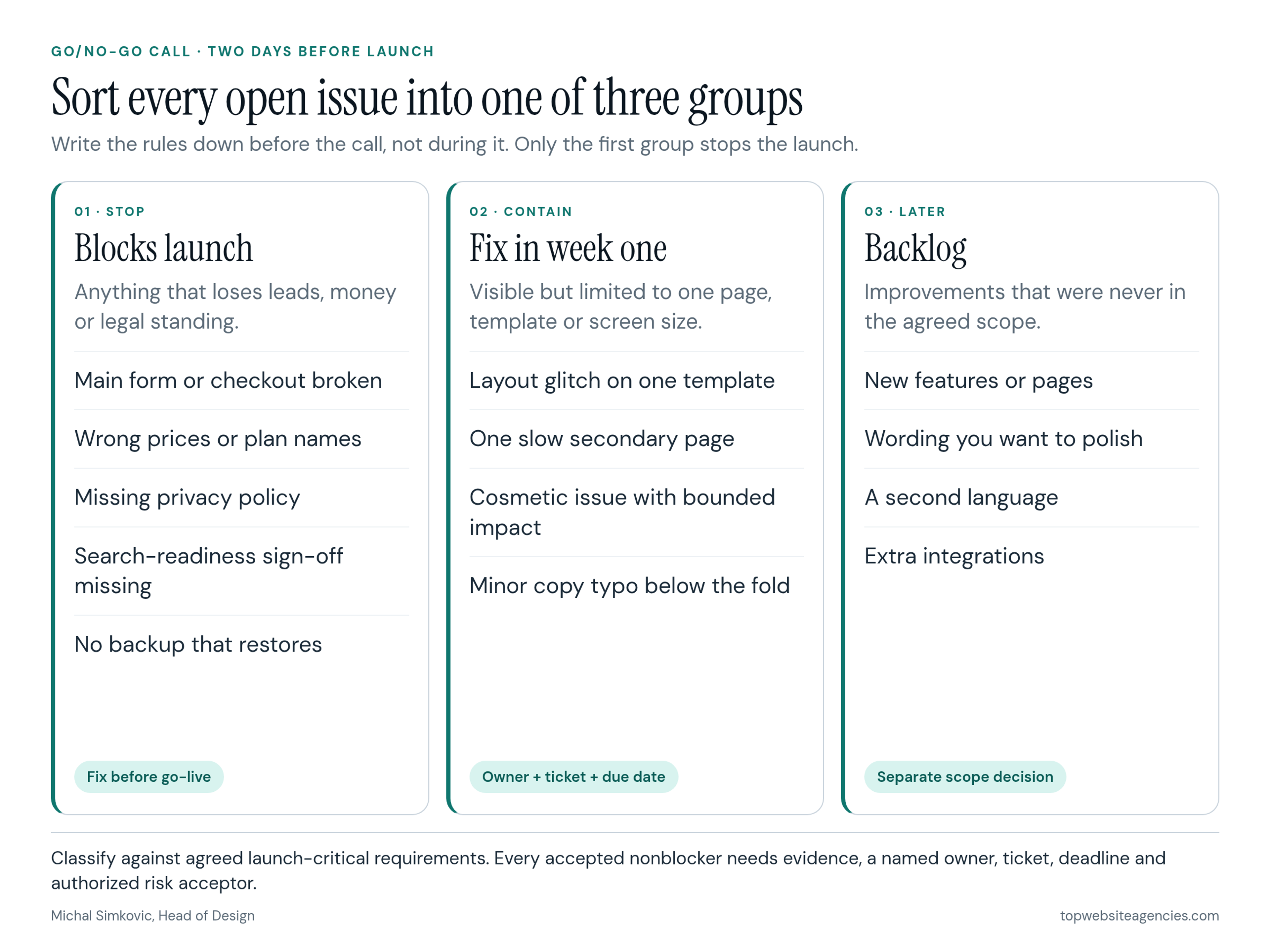
Separate out-of-scope enhancements from release defects. A feature request may belong in the backlog; a failed agreed requirement still needs resolution or a documented decision under the project agreement. Avoid arbitrary rules such as allowing a fixed number of issues. Several small defects can combine to break one important journey.
The client launch authority reviews the evidence with the technical lead. Record one outcome: go, go with accepted nonblockers, or no-go. Include the release identifier, decision time, named approver, accepted ticket IDs and next checkpoint. Pending critical evidence means no-go until resolved. Make clear whether the approver has authority to accept each risk; escalate anything outside it.
Launch Day: A Timed Cutover, Smoke-Test and Communications Runbook
The following times are an illustrative sequence in the team's agreed local time, not guaranteed task durations. Choose a staffed window with time to investigate and recover. Name a deputy for the launch authority and for the deployment operator. If the people or recovery prerequisites are unavailable, postpone the cutover.
- 08:30 — release coordinator [name]. Check: reconfirm attendance, freeze and open tickets. Evidence of pass: attendance acknowledgement, unchanged release ID and current decision record. Post the next update time in the agreed incident channel.
- 08:45 — deployment lead [name]. Check: confirm recovery inputs and data capture before changing production. Evidence of pass: recoverable version or backup identifier, procedure reference and confirmation that the operator can execute it. Escalate a mismatch before proceeding.
- 09:00 — client launch authority [name]. Check: authorize cutover of this release. Evidence of pass: timestamped authorization linked to accepted exceptions. The operator does not infer permission from silence.
- 09:10 — deployment operator [name]. Check: perform the approved platform-specific release or domain change. Evidence of pass: deployment or change log, production release identifier and successful HTTPS reachability check. DNS-dependent changes may need a different schedule because caches and routes can vary.
- 09:25 — QA lead [name]. Check: run the production smoke test on the agreed entry pages and critical journeys from outside the admin session. Evidence of pass: dated results for reachability, navigation and the visitor's confirmation step, tied to the production version.
- 09:40 — sales operations lead [name]. Check: trace the production synthetic form submission to the right CRM queue and notification recipient. Evidence of pass: correlated submission and CRM identifiers, checked fields and delivery time. Clean up test records using the approved process.
- 09:50 — technical lead [name]. Check: review service errors and health signals during the smoke-test window. Evidence of pass: dashboard or log reference and explanation of any unresolved alert. The analytics lead attaches the separate event receipt.
- 10:00 — client launch authority [name]. Check: continue, hold or recover based on the evidence. Evidence of pass: recorded decision, active incident owner if needed, and next review time. A scheduled decision time is not permission to ignore an unresolved blocker.
- 10:15 — communications lead [name]. Check: release internal and external announcements only after operational clearance. Evidence of pass: approval reference and message schedule. If held, notify stakeholders of the hold and next update rather than sending the campaign.
Keep a timestamped change log during the window. A failed smoke test creates an incident record with the affected task, impact and owner. Avoid untracked production edits: every urgent fix needs its own verification and an updated release identity where relevant.
Agree Recovery Triggers and Platform Assumptions Before Launch
Define triggers in observable terms: a critical form does not reach its destination; a checkout cannot complete; a security concern requires containment; or availability fails the launch criteria agreed for this project. Set an investigation deadline for each trigger and decide what happens if evidence remains inconclusive. Do not assume that every incident should wait an arbitrary hour.
Name the client recovery decision-maker and the technical recovery operator separately. The operator explains the consequences, the decision-maker authorizes the agreed action, and the communications lead pauses announcements and gives the next update. Pre-authorize emergency containment where appropriate so a missing approver does not leave the team improvising.
Recovery must match the platform:
- Versioned hosting or static delivery: confirm which prior deployment can be restored, whether its environment settings remain compatible, and whether a separate content system has changed. A code revert does not automatically revert content or external services.
- CMS with database-backed content: identify which code, database and uploaded media belong together. Explain what restoring a backup would do to content edits, orders or submissions created after that backup. Assign reconciliation ownership before restoring anything.
- Hosted site builder: confirm the actual version-history, backup and domain-switch options available on the selected plan. Do not promise a one-click rollback without verifying it for that site.
- DNS-based cutover: document the old origin's availability, certificate and data behavior. Reverting a record may not immediately move every visitor back, so define how both origins will be monitored during the transition.
Evidence of recovery readiness should include the procedure tested or reviewed, what was not tested, the last safe restore point and dependencies that recovery will not reverse. If a forward fix is safer than a restore, document that decision and how the critical journey will be verified afterward. Never promise a recovery time without evidence relevant to this deployment.
Day 1–30: Watch Operations, Then Hand Over
Assign a named watch lead and a backup for each period. The cadence below is a starting plan; adjust it to incident severity and traffic patterns. Automated monitoring should continue between human reviews. A quiet analytics chart is not proof that the site or CRM delivery is healthy.
- Days 1–7 — owner: [operations lead]. Check: review uptime alerts, server or application errors and failures on the agreed critical paths daily. Evidence of pass: dated watch log, alert review and journey-test results. Escalate failures through the same incident ownership used at launch.
- Days 1–7 — owner: [sales operations lead]. Check: reconcile approved test submissions and available delivery records with CRM receipt and routing daily. Evidence of pass: correlated records and a ticket for any gap. Investigate delivery delays separately from changes in demand.
- Days 8–30 — owner: [watch coordinator]. Check: review those operational signals at an agreed cadence, for example weekly after a stable first week, and after relevant changes or alerts. Evidence of pass: review entries covering uptime, delivery, errors and critical journeys, with explicit follow-up owners.
- Day 30 — owner: [client service owner]. Check: complete the operational handover. Evidence of pass: acknowledged account access, monitoring ownership, incident contacts, open tickets with deadlines, and recovery instructions. Do not close unresolved defects merely because the calendar reached day 30.
Keep long-term upkeep separate from this stabilization watch. After handover, use the guide to planning ongoing website maintenance for the next planning conversation. This checklist does not set maintenance prices, service levels or contractual remedies.
Copy-Paste Launch Decision Record
Use one copy per release. Reference the readiness evidence above instead of duplicating every technical test.
- Release/build and content revision: [identifiers]; launch window and time zone: [details].
- Client launch authority and deputy: [names]; deployment operator and deputy: [names].
- Each readiness check: [ID, named owner, pass/fail/pending, evidence link, test time, retest result].
- Blockers: [ticket IDs, impact, owner, next decision time]; do not authorize with unresolved launch-critical evidence.
- Accepted nonblockers: [ticket, affected task, workaround, owner, due date, authorized risk acceptor].
- Recovery: [trigger, decision-maker, operator, procedure, last safe restore point, data consequences].
- Decision: [go / go with exceptions / no-go, approver, time, release ID].
- Communications: [named sender, announcement approval, hold message, next update].
- Watch and handover: [named leads, signal sources, review cadence, incident contact, day-30 recipient].
- Contractual acceptance: [separate record reference, if applicable]; operational launch authorization alone does not settle it.
Fictional Worked Example: A 35-Page B2B Website
This is a fictional planning example, not a client case study or a report of measured outcomes. Assume a B2B software company is preparing a 35-page marketing site on a hosted CMS. All names, assignments and times below are illustrative. There are no claimed defect counts, conversion gains or successful launch results.
Dana, the client marketing lead, is the launch authority. Luis, in sales operations, owns form-to-CRM evidence. Priya, the delivery team's technical lead, owns deployment and recovery. Morgan owns communications. Before the review, they replace the generic role labels with those names and agree who can act as deputy.
Dana's content check requires an approved inventory of the 35 pages. Luis's delivery check requires an approved synthetic demo request matched to its CRM record. Priya's recovery check requires confirmation of the CMS's available restore functions and the effect of a restore on new submissions. A checkbox without those attachments remains pending.
In this hypothetical scenario, an unverified CRM route is a blocker, not an issue to accept after launch. A contained cosmetic defect can be considered a nonblocker only after its impact is described, a ticket and deadline assigned, and Dana accepts the residual risk within her authority. The example does not assume either issue was actually found or fixed.
At the illustrative 09:00 gate, Dana authorizes cutover only if the evidence is complete. Priya performs the change; Luis traces a production test lead; Morgan holds the campaign until Dana records operational clearance. A failed critical path activates the agreed investigation and recovery decision rather than an automatic announcement.
During the watch period, Luis reviews delivery evidence and Priya reviews service health. At day 30, Dana receives the ownership and open-ticket record. Contractual acceptance remains a separate decision under the agreement, regardless of whether the site is serving visitors.
Frequently Asked Questions (FAQ)
Who owns the website launch checklist?
A named client coordinator maintains the record, while individual checks have their own accountable owners. The client launch authority decides whether to expose the release to visitors, informed by the technical lead's evidence. Avoid assigning a check to “both” without naming one accountable person.
How much evidence is enough?
Enough to show that the specific requirement passed on the relevant release and environment. For a lead route, keep the test identifier, CRM match and routing confirmation. For recovery, keep the procedure and its verified limits. A screenshot with no date or release context may not establish readiness.
Can we launch with open tickets?
Only when they are genuinely nonblocking under the agreed criteria and explicitly accepted by someone with authority. Each needs a bounded impact, workaround where relevant, owner and due date. An incomplete critical check is not a nonblocker merely because the launch date is close.
Is a successful staging test enough?
No. Production has its own domain, accounts and integration configuration. Use a short production smoke test and trace critical delivery after cutover. The staging review supports readiness; it does not replace confirmation that the live release serves the intended journeys.
Does launch approval start a warranty or trigger payment?
Do not infer that from this checklist. The agreement determines contractual consequences. Record operational authorization distinctly and consult the separate acceptance record when needed.
When should announcements go out?
After the launch authority records operational clearance using the live evidence. A planned campaign time is not clearance. Name the person who can pause communications and tell stakeholders when the next decision will occur.
Conclusion
A useful website launch checklist turns “ready” into a traceable decision: one named owner per check, evidence tied to the release, explicit treatment of blockers and accepted exceptions, and a timed runbook with a credible recovery path. Keep specialist SEO work and contractual acceptance in their own records. Then watch uptime, lead delivery, errors and critical journeys through day 30, and hand over the remaining work to named people.