A strategic website for a growing US B2B business typically costs about $50,000 to $120,000 in 2026, and the features behind the pages decide where a quote lands in that range. In the worked 40-page example below, the build comes to $87,000 and the three-year total to about $141,000. The visual design is rarely what moves the number. What moves it are the parts a business buyer depends on: forms that reach the right salesperson, a resource library, copy that explains a technical product, a safe migration of the URLs you already rank with, and the security and accessibility reviews a buying committee asks for.
If you are comparing B2B web design agencies that handle long sales cycles, knowing which of those parts you need before the first call is what makes their proposals comparable. A quote for "a 40-page website" tells you very little until you know which features sit behind those pages.
This guide prices the B2B-specific features one by one, walks through a worked budget for a 40-page lead-generation site with hours, a stated hourly rate and a three-year total, and lists the lines that first quotes often leave out. If you want a short list of teams once the scope is clear, our editor-reviewed directory of website design partners is the place to start; this article stays on the budget.
In short, US B2B sites in 2026 fall into three bands: $15,000 to $40,000 for a production-led site, $50,000 to $120,000 for a strategic site, and $150,000 and up for an enterprise program. Our guide on how to choose a team for a complex B2B sale explains what each band includes and how to vet the team. For how B2B budgets compare with brochure sites and online stores, see what websites of every size cost in 2026.
What Drives a B2B Website Budget
A B2B website behaves more like a small product than a brochure. In my design leadership roles at product companies such as Copy.ai and HackerRank, and at AWS, the visible layer was never where most of the hours went. The work sits underneath, in these areas:
- CRM and marketing automation: connecting forms to Salesforce or HubSpot is more than pasting an embed code. Someone has to set up hidden source fields, lead routing by company size or region, and the rules for what happens after a form is submitted.
- Gated content and resource libraries: buyers read white papers, technical guides and webinar recordings over a long consideration cycle. A filterable library with form-gated downloads needs a real content model in the CMS.
- Product data and documentation: hardware makers and technical software companies often need spec sheets, downloadable documents and, sometimes, a feed from a product database or ERP system.
- Number of unique templates: a 50-page site built from five layouts can cost less than a 20-page site that needs fifteen. Templates drive design and development hours far more than page count does.
- Copy and case studies: writing for engineers, procurement teams and executives takes interviews with your product people and your customers. It is one of the largest lines in a strategic build.
- SEO migration: changing URLs without a full redirect map can cost you search traffic you spent years building. Every old URL that matters needs a mapped destination and a check after launch.
- Security, compliance and accessibility: enterprise buyers send security questionnaires before they sign, and many expect the site to meet the AA level of the current WCAG guidelines. Both add review and testing rounds.
What Each B2B Feature Adds
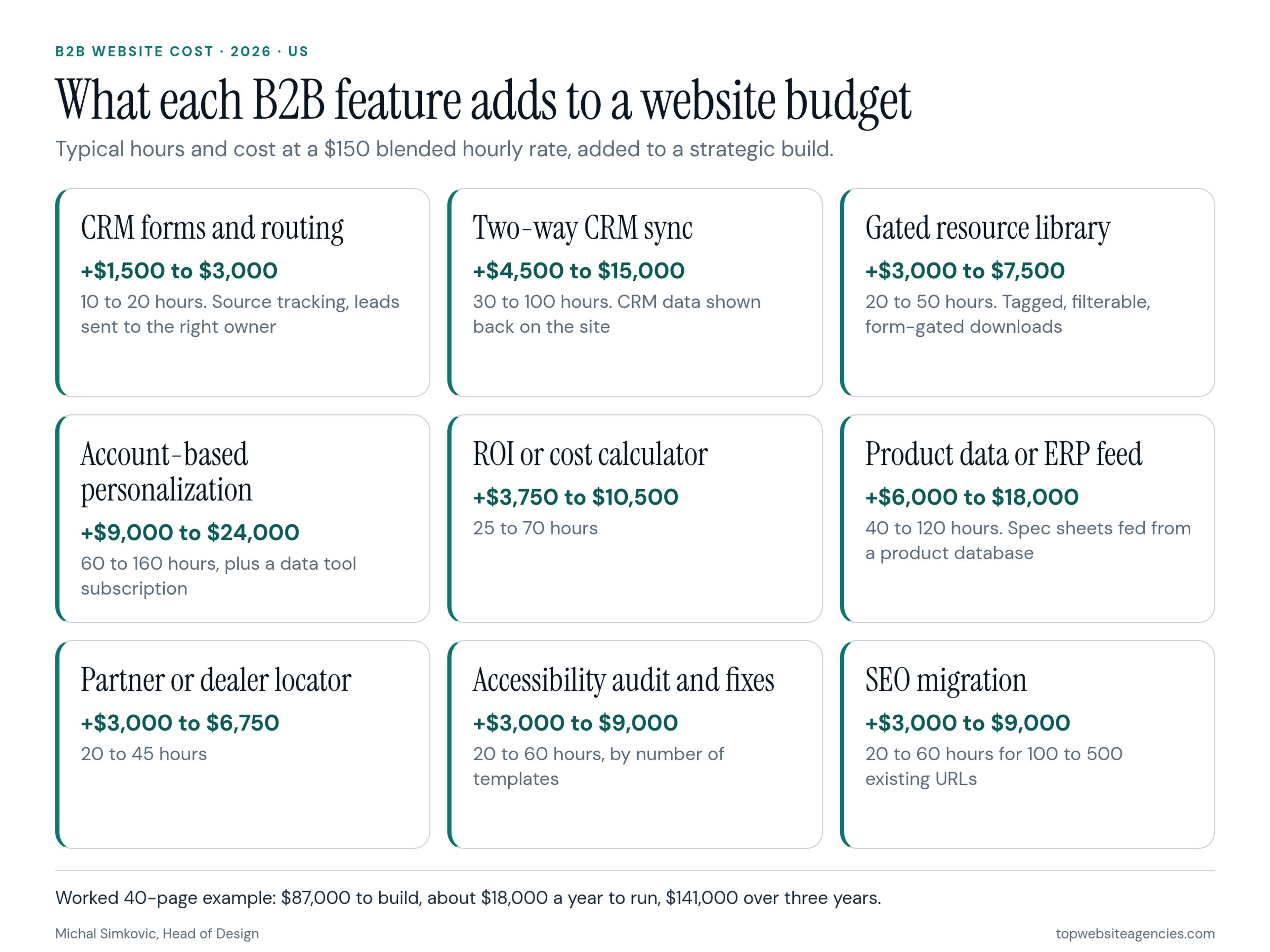
The ranges below show what each feature typically adds to a strategic build, expressed as hours and then as dollars at a $150 blended hourly rate, so you can re-price them with the rate in your own quotes. Each item also says when you can safely leave it out of the first release.
- CRM-connected forms with routing and source tracking: 10 to 20 hours, about $1,500 to $3,000. Captures where each lead came from and sends it to the right owner. Skip it if one inbox or one sales pipeline handles every inquiry.
- Two-way CRM sync for known accounts: 30 to 100 hours, about $4,500 to $15,000. Pulls CRM data back to the site, for example to show returning customers different content. Skip it unless you run a customer area or a renewal motion on the site.
- Gated resource library: 20 to 50 hours, about $3,000 to $7,500. A tagged, filterable library with form-gated downloads. Skip it at first by publishing your first two or three guides on standard landing pages with one form.
- Account-based personalization: 60 to 160 hours, about $9,000 to $24,000, plus a subscription to a company-identification data tool. Changes headlines or proof points by visiting company or industry. Skip it until your core pages convert without it.
- ROI or cost calculator: 25 to 70 hours, about $3,750 to $10,500. Skip it if a clear pricing page and one worked example already answer the buyer's math.
- Product data or ERP feed: 40 to 120 hours, about $6,000 to $18,000. Skip it if your catalog changes a few times a year and can be edited by hand in the CMS.
- Partner or dealer locator: 20 to 45 hours, about $3,000 to $6,750. Skip it if your partner list fits on one page.
- Security and trust page: 10 to 25 hours, about $1,500 to $3,750 for structure, design and copy. This is not the cost of an audit, only the page that presents your security posture.
- Accessibility audit and fixes: 20 to 60 hours, about $3,000 to $9,000, depending on how many templates need testing.
- Additional language: 60 to 200 hours per language for setup, about $9,000 to $30,000, plus ongoing translation. Defer it until revenue from that region justifies a maintained local version.
- SEO migration: 20 to 60 hours for 100 to 500 URLs, about $3,000 to $9,000. Rarely worth skipping on a site with organic traffic.
A Worked Budget for a 40-Page B2B Site
This is an illustrative model, not a quote and not a survey. The hours reflect how proposals for strategic B2B sites usually split the work; the $150 blended rate is an assumption you should replace with the rate in your own quotes. The method is simple: hours for each line multiplied by the rate, then running costs added for three years at flat prices.
The scenario: a 40-page lead-generation site for a mid-sized US software company. It has two industry landing paths, CRM-connected forms with routing, a gated resource library, a security and trust page, new copy for about 15 core pages and two case studies, and 150 existing URLs to migrate. The 40 pages are built from eight unique templates; the rest are filled from the CMS.
Build cost, hours × $150:
- Discovery and positioning: 60 hours × $150 = $9,000
- UX architecture and sitemap: 80 hours × $150 = $12,000
- Visual design and component system: 120 hours × $150 = $18,000
- Copywriting and two case studies: 100 hours × $150 = $15,000
- CMS build and front-end development (eight templates): 120 hours × $150 = $18,000
- CRM forms, routing and gated library: 40 hours × $150 = $6,000
- SEO migration, 150 redirects and checks: 30 hours × $150 = $4,500
- QA, accessibility checks and launch: 30 hours × $150 = $4,500
Total build: 580 hours, $87,000.
Running costs in year 1, stated assumptions:
- CMS plan and hosting: about $300 a month, $3,600 a year, for a mid-tier plan on a Webflow- or WordPress-class stack.
- Form, scheduling and analytics tools: about $200 a month, $2,400 a year.
- Support retainer: 6 hours a month × $150, $10,800 a year, for new case studies, page edits and small fixes.
- Font, image and plugin licenses plus uptime and security monitoring: about $1,200 a year.
Year 1 running costs: $18,000. Three-year total cost of ownership: $87,000 + 3 × $18,000 = $141,000.
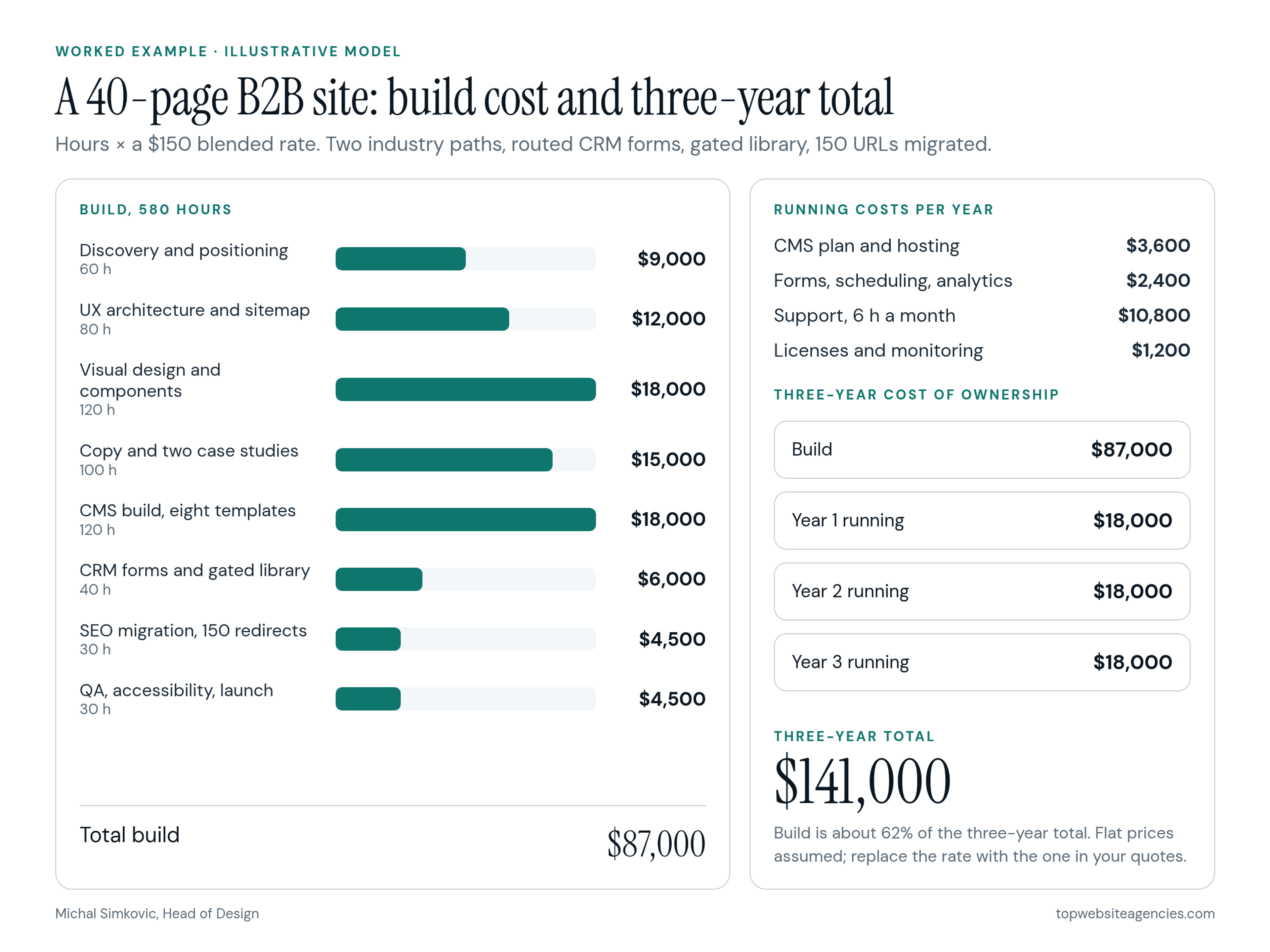
Three things stand out in this model. First, the build is only about 62% of the three-year cost; the remaining 38% goes to keeping the site current. Second, copy and content work is 17% of the build, more than the CRM and migration lines combined. Third, the rate matters more than any single feature: the same 580 hours cost $72,500 at $125 an hour and $116,000 at $200 an hour. Both totals stay inside the $50,000 to $120,000 strategic level, so a quote far outside that band for a similar scope deserves a line-by-line question.
If your company already runs on HubSpot, the CMS line changes. HubSpot's own Content Hub plan page lists Professional from $500 a month with three seats included and Enterprise from $1,500 a month, so the CMS line alone would be at least $6,000 a year instead of $3,600, in exchange for native CRM forms and reporting.
Lines That First Quotes Often Leave Out
Low first proposals often look low because they leave out work that someone still has to do. When that work surfaces late, it comes back as a change order. Ask whether each of these is in the scope, and who owns it:
- Content migration and formatting: moving dozens of old blog posts or documents by hand, fixing images and formatting. Ask whether your team or the studio moves pages that cannot be imported automatically.
- CRM field mapping and lead-flow testing: building a form is quick; mapping its fields to CRM properties and testing the full path with your revenue operations team is not. Ask for an end-to-end test in the scope.
- Legal and security review rounds: your legal and security teams will review third-party scripts and data capture. Ask how many review rounds the price covers.
- Analytics events and cookie consent: event tracking and a consent banner that matches your privacy obligations take setup time. Name one owner for the tag setup.
- Licenses billed outside the quote: commercial fonts, stock images and paid plugins. Ask which licenses are included and which you buy directly.
- A post-launch fix window: problems show up once real traffic arrives. Ask for a fix window, often 30 days, with bug fixes at no extra charge.
Running Costs After Launch
A B2B site keeps costing money after launch, and the three-year view above is the most honest way to budget it. Expect recurring lines for hosting and the CMS plan, marketing automation seats, scheduling and analytics tools, licenses, and either a retainer or an internal owner who publishes case studies, updates pricing pages and keeps security documents current.
In the worked example, running costs come to about a fifth of the build each year. Sites with heavy integrations or several languages run higher. For retainer models, service levels and upkeep by site type, see our breakdown of what post-launch upkeep costs by site type.
FAQ
Why do two proposals for the same sitemap differ by three times?
The lower one usually assumes template-based layouts, your own copy and light testing. The higher one includes discovery, positioning, copywriting, a planned SEO migration and testing across devices and browsers. Compare the hours behind each line, not the totals.
Should a B2B site use HubSpot CMS, Webflow or WordPress?
WordPress has the largest pool of developers and low software fees, but it needs regular plugin and security upkeep. Webflow speeds up visual development and removes server maintenance, with limits on very large content collections. HubSpot CMS connects natively to HubSpot CRM, which suits teams already on that system, at a higher monthly platform fee.
Can we phase the build to spread the cost across quarters?
Yes. A first release with your core product pages, positioning and contact paths lets you start collecting leads early. The resource library, calculators and regional versions can follow in a second phase, priced as separate line items.
How much of the budget should go to copy?
In the worked example, copy and case studies are $15,000 of an $87,000 build, about 17%. Sites with many case studies or technical pages can push that toward a quarter of the build. Cutting it rarely saves money, because a well-built site with generic copy still loses technical buyers.
Is a production-led build enough for an early-stage company?
Often, yes. A company still testing its positioning is better served by a lean build on clean templates, with CRM-connected forms and one or two case studies, than by an $80,000 strategic program. It can add the library, personalization and other features once the message and the sales motion are proven.
Conclusion
A B2B website budget is set by its functions, not its page count. Every routed form, gated library, data feed and migrated URL needs design and engineering hours, and every one of them can be priced before you sign. List the features you need, decide which ones can wait for a second phase, ask for hours and a rate behind each line, and budget the next three years, not just the launch. With that scope written down, you can compare proposals from B2B-focused design teams on equal terms.