The right B2B web design agency builds your site for a buying committee, not a single visitor. Before it designs a page, it studies how your deals are won and lost, then plans proof for every person who can say no: the champion, the finance lead, the security reviewer, and procurement. Hire the team that asks for your sales calls, writes the copy itself, connects forms to your CRM, and hands you full ownership at launch. Visual polish is the easy part to find.
The gap between agencies is wide. I reviewed 312 B2B web design proposals while editing the Top Website Agencies rankings. On average, 86% of the scoped hours went to visual design and development, and only 14% went to positioning, buyer research, and messaging. That ratio explains why so many B2B redesigns look better and sell no better.
Below: what makes B2B web design different, what your site must do for each member of the buying committee, how to evaluate an agency's discovery and content process, what US agencies charge in 2026, and the questions and red flags I use when I assess agencies.
What Makes B2B Web Design Different
A consumer site usually persuades one person in one session. A B2B site has to survive a long, shared evaluation where your company is often not in the room.
Two numbers frame the problem. Forrester's research on B2B buying networks reports that 73% of purchases involve three or more departments, with an average of 13 people inside the buyer's organization and nine from outside involved in the decision. And G2's 2025 Buyer Behavior Report found that two-thirds of software buyers prefer to talk to sales only after doing their own research.
Put those together and your website becomes the sales rep for most of the cycle. It has to:
- Explain what you do in plain language to people outside your category, including finance and legal.
- Arm your champion with pages, numbers, and documents they can forward internally.
- Answer objections before a call: price range, security, integration effort, switching risk.
- Route serious buyers to the right next step and tell sales what each account has already read.
Leading design teams at Copy.ai, Around, HackerRank, and AWS taught me that the visitors who decide deals are rarely the ones a homepage is designed for. An engineering manager, a security reviewer, and a finance partner will each judge the same product on very different evidence.
What a B2B Website Must Do for the Buying Committee
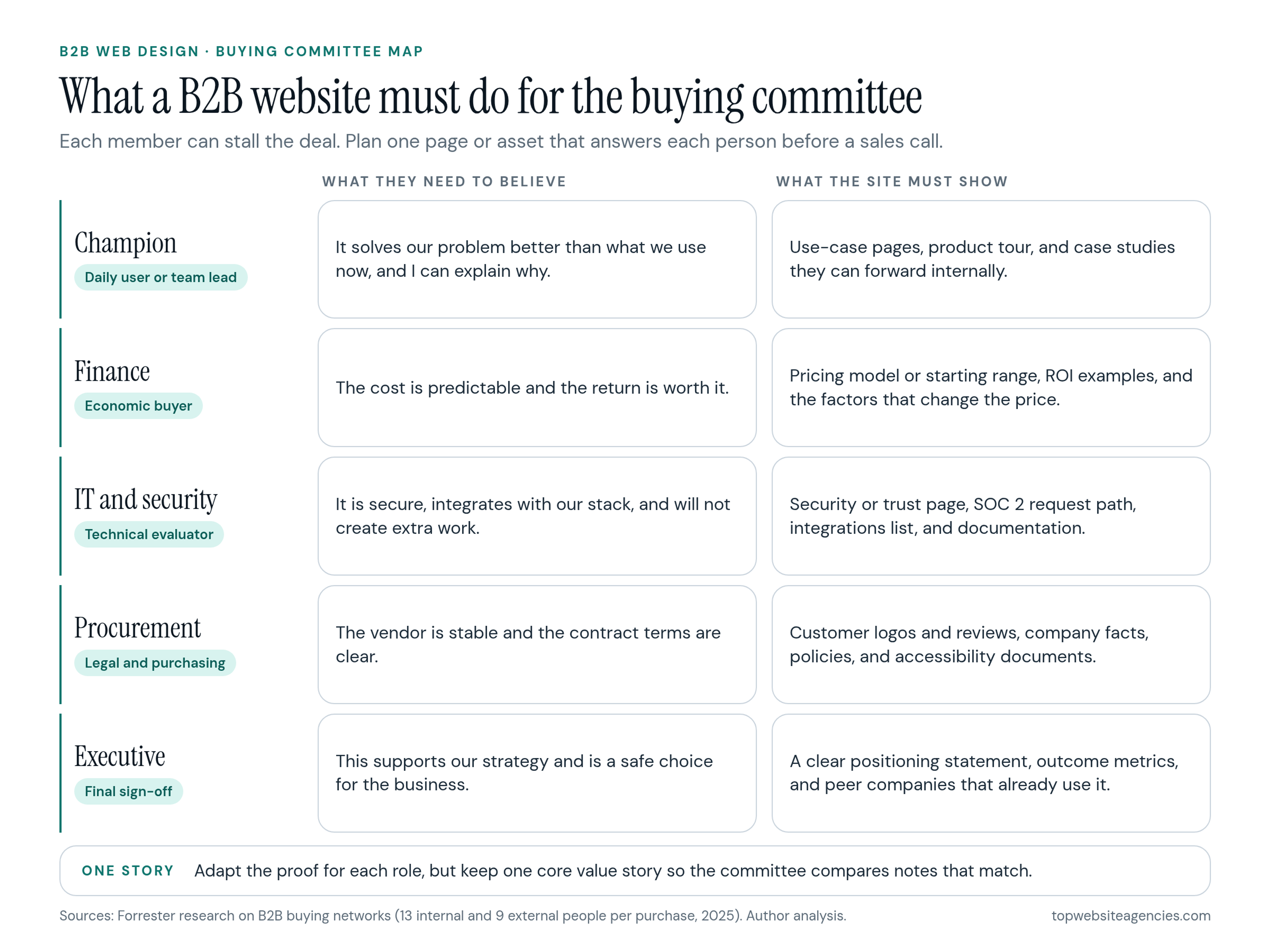
Start by mapping who reads the site and what each person needs to stop worrying. A good agency does this in discovery and turns it into your sitemap.
Positioning a stranger understands in ten seconds
Your homepage headline should say what you sell, for whom, and why it is different, without insider jargon. If a CFO cannot repeat it back, the rest of the site has to work twice as hard. Ask the agency to show positioning work from past projects, not just final layouts.
Role and industry paths that tell one story
Solution pages by role, use case, or industry help visitors find their context fast. The trap is writing a different promise for every audience, so the committee ends up comparing notes that do not match. Strong agencies keep one core value story and adapt the proof, examples, and vocabulary for each path.
Pricing guidance, even for enterprise deals
You may not publish a rate card, but you can publish a pricing model, starting points, or the factors that move the price. In the TrustRadius 2025 B2B buyer research takeaways, transparent pricing information was the number one thing software buyers said they would change about the buying process, and 77% of buyers looked at user reviews when making a purchase. A ballpark range filters out buyers who cannot afford you and gives the right ones a number to take to finance.
Proof that reads like business reporting
Case studies should state the starting problem, what changed, measurable results, and how long implementation took. Put customer logos, reviews, and named quotes near the claims they support. Comparison pages against legacy tools or the status quo help evaluators who must justify switching.
Security, compliance, and procurement pages
Security reviewers look for a trust or security page early. If you hold a SOC 2 report, say so and explain how buyers can request it. SOC 2 is an attestation on a service organization's controls relevant to security, availability, processing integrity, confidentiality, or privacy, under AICPA SOC reporting standards. If you sell software to US federal agencies, expect requests for an Accessibility Conformance Report, the document government buyers use to check a product against the Revised 508 Standards. Your agency should design these pages and make the documents easy to request.
CRM and marketing automation that sales trusts
Forms must pass clean data to Salesforce, HubSpot, or Marketo, route leads by company size, region, or product, and keep attribution intact. Ask the agency who on its team configures this and which CRM projects it has shipped. A beautiful demo form that drops leads into a shared inbox will cost you more than the redesign.
How a Strong B2B Agency Runs Discovery
You can tell a strategic partner from a production shop in the first two weeks.
A production shop sends a brand questionnaire about colors and competitor sites, then asks you for a sitemap and finished copy. A strategic agency asks for:
- Recorded sales calls (Gong, Chorus, or similar) to hear real objections and the words customers use.
- Interviews with your best account executives and sales engineers about where deals stall.
- Win and loss notes to learn why buyers chose you or a competitor.
- Customer interviews with three to five recent buyers from different roles.
- Analytics and search data to see which pages already pull in qualified traffic.
The output should be a written messaging framework, a buyer-committee map, and a sitemap tied to that map, approved before design starts. If an agency proposes homepage concepts in week one, it is designing from assumptions.
How to Evaluate a B2B Web Design Agency
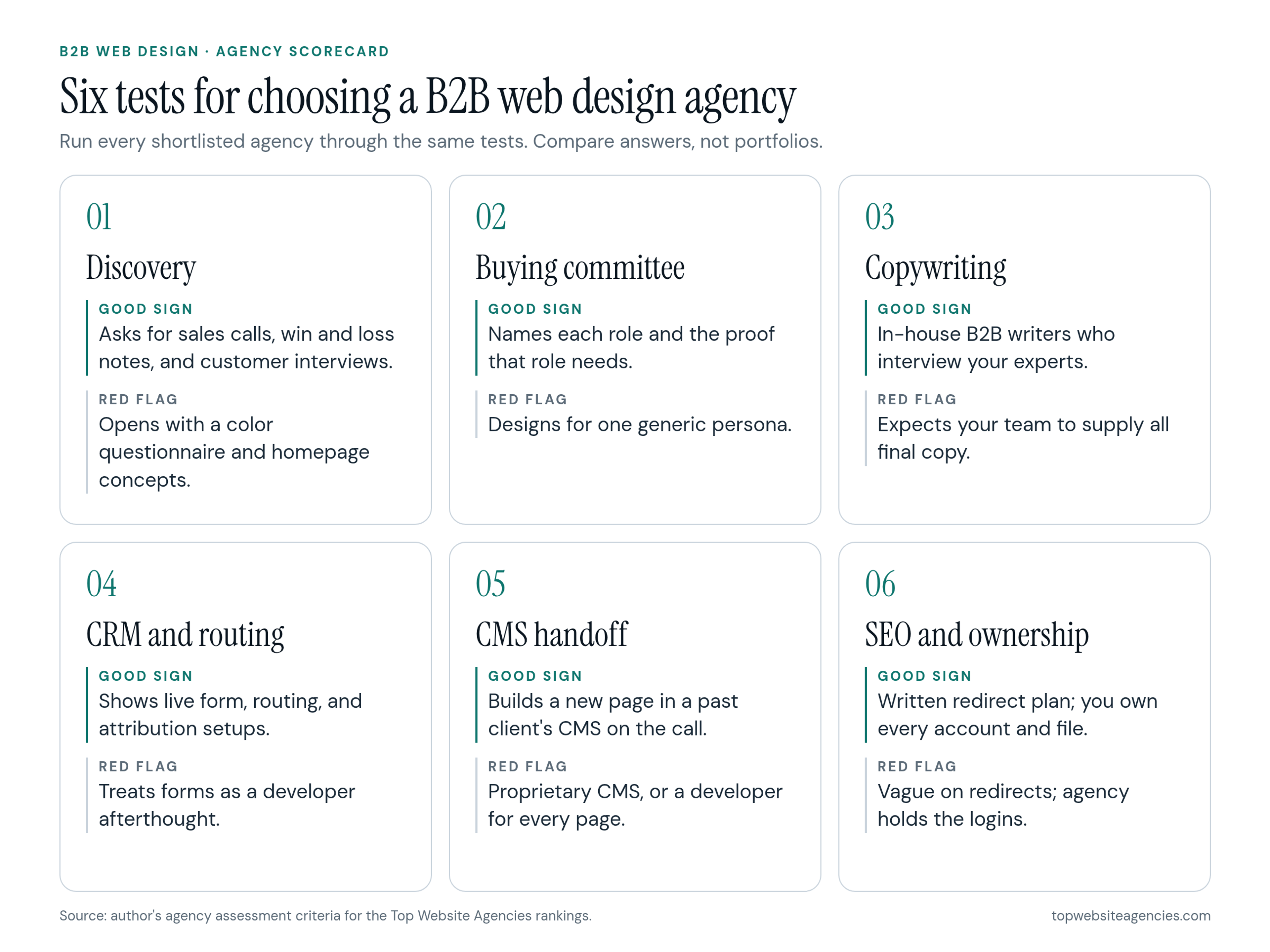
When proposals arrive, look past the portfolio and test how each agency works. I score every shortlisted agency on the same six tests.
Strategy versus production
Read the case studies. Do they mention pipeline, lead quality, sales-cycle feedback, or conversion by segment? Or only awards and device mockups? You want a partner that measures success in sales outcomes.
Who writes the content
Copy is the most common reason B2B projects slip. If the agency expects your marketing team to write forty pages of technical copy alongside their day jobs, add months to the plan. Prefer agencies with in-house B2B writers who interview your experts and draft the messaging themselves.
CMS your marketers can use
Ask the agency to share its screen and build a new landing page in the CMS of a recent project, live on the call. If your team will need a developer for every campaign page, the site will age fast. Webflow, WordPress, or a headless CMS such as Sanity can all work; a proprietary system you cannot take elsewhere should not.
SEO and migration discipline
A redesign that breaks URLs can erase years of organic demand. The agency should own a redirect map, a pre-launch crawl, and post-launch monitoring. Our guide to keeping rankings intact through a redesign lists what to put in the contract.
Questions to ask in the pitch
- "How would you map the buying committee for a product like ours?" Listen for named roles and the evidence each one needs.
- "Walk me through a project where your work improved lead quality, and how you measured it."
- "Who writes the copy, and how many interviews does that include?"
- "How will forms, routing, and attribution work with our CRM?"
- "Who exactly will work on our account each week?" Get names, not titles.
- "How do you protect organic traffic during the migration?"
What B2B Web Design Costs in the US (2026)
Price follows strategic depth, number of templates, integrations, and migration size. These are the ranges I see in US agency proposals in 2026:
- $15,000 to $40,000: production-led sites. Custom design on a standard CMS, usually from your sitemap and your copy. Fine for an early-stage company that needs a credible presence, thin for a complex sale.
- $50,000 to $120,000: strategic B2B sites. Discovery with sales and customers, positioning, copywriting, a modular design system, CRM integration, and an SEO migration. This is where most growing SaaS and B2B services companies land.
- $150,000 and up: enterprise programs. Hundreds of pages, multiple products or regions, localization, complex permissions, accessibility audits, and many stakeholders.
What pushes a quote up: more unique templates, interactive product tours, gated resource libraries, multi-language content, and migrating thousands of posts. Timelines follow the same pattern; strategic B2B sites typically take 12 to 20 weeks in the projects I review, longer when legal and security reviews add rounds.
Budget beyond the build, too. Plan for CMS and hosting fees, form and scheduling tools, stock or custom photography, and a monthly retainer or internal owner for updates. A B2B site that nobody maintains starts losing deals within a year, because pricing pages, case studies, and security documents go stale first.
Red Flags
- No request to speak with sales. The agency sees the site as an art project, not a revenue tool.
- A four-week timeline for a complex sale. Discovery is being skipped, and a template is being reskinned.
- The senior team pitches, then disappears. Ask who runs the project day to day.
- Undisclosed subcontracting. Ask who writes the code and where; surprises here become maintenance problems.
- Motion over clarity. A pitch built around scroll animations often hides weak information architecture and slow pages.
- Vague answers on SEO and redirects. Expect a written migration plan, not reassurance.
B2B Specialist or Generalist Agency?
You do not always need an agency that works only with B2B companies, but you do need one that has shipped sites for a sale like yours. Three signals matter more than the label on its homepage:
- Comparable deal size and cycle. An agency used to $500 subscriptions plans a different site than one used to six-figure contracts with security reviews.
- Comparable buyers. Selling to developers, hospital administrators, or manufacturing plant managers each calls for different proof and vocabulary.
- Comparable stack. Experience with your CMS, CRM, and analytics setup shortens the project and lowers launch risk.
A generalist with two strong, relevant case studies can beat a self-described B2B specialist whose work is mostly brochure sites. Ask to speak with the team members who did that work.
Running the RFP and Selection Process
Keep the RFP focused on business problems, not a feature wish list: your sales-cycle length, average contract value, buying committee, current conversion bottlenecks, CRM stack, page count, and deadline. Our guide to writing an RFP agencies can price accurately includes a template.
Then shortlist three to five agencies, give each the same brief, and hold a working session rather than a slide pitch. Call two references per finalist and ask what went wrong on their project and how the agency handled it. The answer tells you more than any case study.
Ownership and Handoff
Your company should own the domain, hosting, CMS, analytics, tag manager, and marketing automation accounts, with the agency invited as a user. The contract should transfer the code, design files, and all written content to you on final payment. Ask for a handoff package: CMS training, a component guide, and short videos showing how to build pages, so your team is not dependent on the agency after launch.
Frequently Asked Questions (FAQ)
What is B2B web design?
B2B web design is planning, writing, designing, and building websites for companies that sell to other businesses. It focuses on long, multi-stakeholder sales: clear positioning, proof for each decision maker, pricing guidance, security information, and CRM-connected lead capture.
How is B2B web design different from B2C?
B2C sites usually convert one person quickly. B2B sites support a committee over weeks or months, so they need deeper content, role-specific proof, and handoffs to sales instead of a simple checkout.
How much does a B2B website cost?
In 2026 US agency proposals, expect about $15,000 to $40,000 for a production-led site, $50,000 to $120,000 for a strategic B2B site with discovery, copy, and CRM integration, and $150,000 or more for enterprise programs.
How long does a B2B website redesign take?
Strategic B2B sites typically take 12 to 20 weeks from discovery to launch. Large enterprise sites with many products or regions can take six months or more.
Should a B2B website show pricing?
Show at least a pricing model, a starting point, or the factors that drive cost. Buyers want transparent pricing, and even a range helps your champion get budget approved.
Conclusion
Choose a B2B web design agency the way your buyers choose you: on evidence. The right partner studies your sales conversations, plans proof for every member of the buying committee, writes the copy, connects the site to your CRM, protects your search traffic, and leaves you owning everything. Price the strategy and integration work, not just the design. When you are ready to compare vetted partners, start with B2B web design agencies and run each one through the six tests and pitch questions above.