Founders ask me the same question every week: what should a new business website actually cost? The honest answer is a range, and a wide one. In the US market, a business website costs anywhere from a few hundred dollars a year on a DIY builder to well over $100,000 for a custom build with a full design and engineering team. This guide explains what sits behind that gap, how to set a realistic budget, and which expenses most teams forget.
During my time leading design teams at Copy.ai, Around, and HackerRank, and as editor of the Top Website Agencies rankings, I have reviewed hundreds of project proposals. Many quotes stay vague on purpose, because a vague scope is easier to sell. The ranges below replace that ambiguity with numbers you can plan around, and once you know your tier, you can compare website design agencies ranked by our editorial team with a clear brief in hand.
The Five Tiers of Website Cost
Cost scales with the size of the team working on your project and the amount of custom work they do. Based on the proposals I review, the US market splits into five tiers.
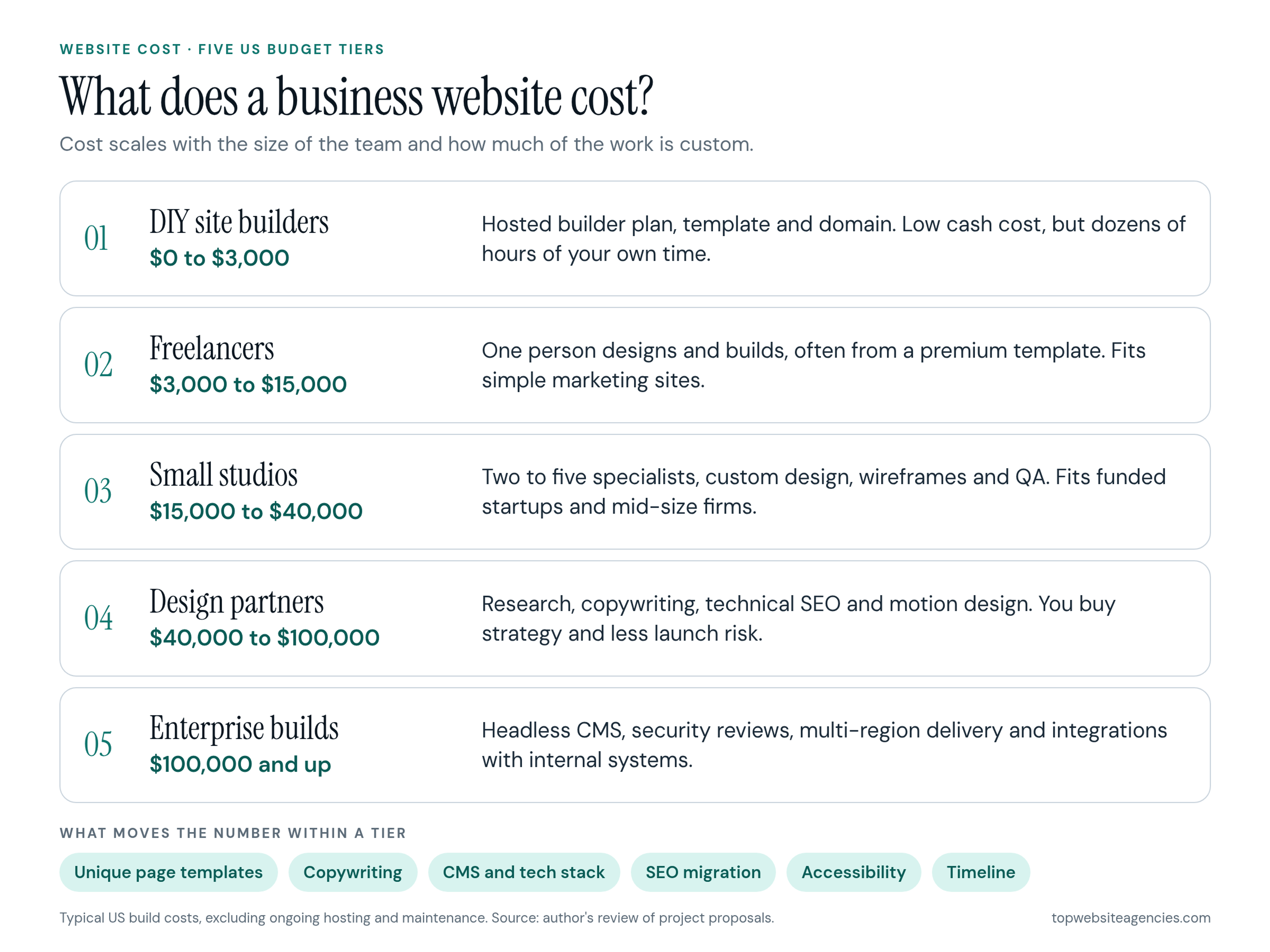
1. DIY Site Builders ($0 to $3,000)
Many early-stage founders start here. You pay a small subscription to a hosted builder: WordPress.com's published plans, for example, run from $9 to $40 a month on monthly billing, with lower rates on annual terms. Add a premium template, a domain and a few paid add-ons, and the first-year spend rarely passes a few thousand dollars.
The financial cost is small, but the operational cost is your time. You will spend dozens of hours writing copy, sourcing images and bending a pre-made template to fit your brand. The result usually looks like a template.
2. Independent Freelancers ($3,000 to $15,000)
You hire one person to handle design and development. In the proposals I see, experienced US-based freelancers charge roughly $75 to $150 per hour. Most work in Webflow or WordPress and start from a premium template to save time.
This tier works well for simple marketing sites. The main trade-off is a single point of failure: one person handles user experience, visual design, technical setup and project management. If that person gets sick or overbooked, your launch date moves.
3. Small Studios ($15,000 to $40,000)
A small studio assigns two to five specialists to your project. You usually get a dedicated project manager, a UI designer and a front-end developer. This tier buys custom design work instead of template modification, plus basic wireframing and quality assurance testing.
Small studios are the sweet spot for funded startups and mid-size businesses generating roughly $1M to $10M in revenue.
4. Established Design Partners ($40,000 to $100,000)
At this level you are buying strategy and risk reduction, not only pages. The team adds user researchers, copywriters, technical SEO specialists and motion designers. They run stakeholder interviews, map user journeys and build custom interactions, and design decisions are backed by research instead of taste.
You are paying for the certainty that the site will convert visitors and represent your brand well on launch day.
5. Enterprise Builds ($100,000 and Up)
Enterprise projects involve complex, scalable architecture. Many use a headless CMS, connecting a custom front-end framework to a separate content repository. These builds require security reviews, multi-region content delivery, localization and custom integrations with internal systems such as CRMs, ERPs and identity providers.
Which Tier Fits Your Business?
Match the tier to the job the website has to do, not to the budget you wish you had:
- Validating an idea or a local service business: a DIY builder or a freelancer is enough. Spend the savings on copy and photography.
- Generating leads with a small marketing team: a freelancer at the top of their range or a small studio. You need a CMS your team can edit without a developer.
- Selling to other businesses after a funding round: a small studio or an established design partner. Positioning, messaging and conversion paths matter more than visual polish.
- Running a large catalog, several regions or strict security reviews: an established partner or an enterprise build. Online stores have their own cost structure, which we break down in our guide to what online stores cost on Shopify versus a custom build.
Core Cost Drivers: What Moves the Number?
When two similar-looking websites carry very different price tags, the variables below are usually responsible.
- Unique page templates: Websites are priced by unique layouts, not total pages. A 50-page site with three unique layouts (homepage, about page, blog post) costs much less than a 15-page site where every page needs its own custom structure.
- Content and copywriting: Someone has to write the words. If you expect your design partner to interview your subject matter experts and write conversion-focused copy, add roughly $300 to $1,000 per page to your budget.
- CMS and technology stack: The content management system dictates the development effort. Decoupling the front end from the back end in a headless build requires specialized engineering and pushes costs significantly higher.
- SEO migration: If you are replacing an existing site, every old URL has to map to a new one with a permanent 301 redirect. Google's documentation on redirects explains that a permanent redirect tells Search to show the new URL in results. Skip the mapping and you can lose much of your organic traffic. A proper migration needs a technical audit and manual mapping, which is a big reason redesign budgets vary so much by scope.
- Compliance and accessibility: WCAG 2.2 is the most recent version of the web accessibility guidelines, as MDN's overview of WCAG notes. Meeting its AA level means checking color contrast, testing keyboard navigation and supporting screen readers, which adds testing phases and developer hours.
Fixed Price, Hourly or Retainer: How Billing Models Change the Cost
Design teams use three main billing structures. Know which one you are signing before you compare totals.
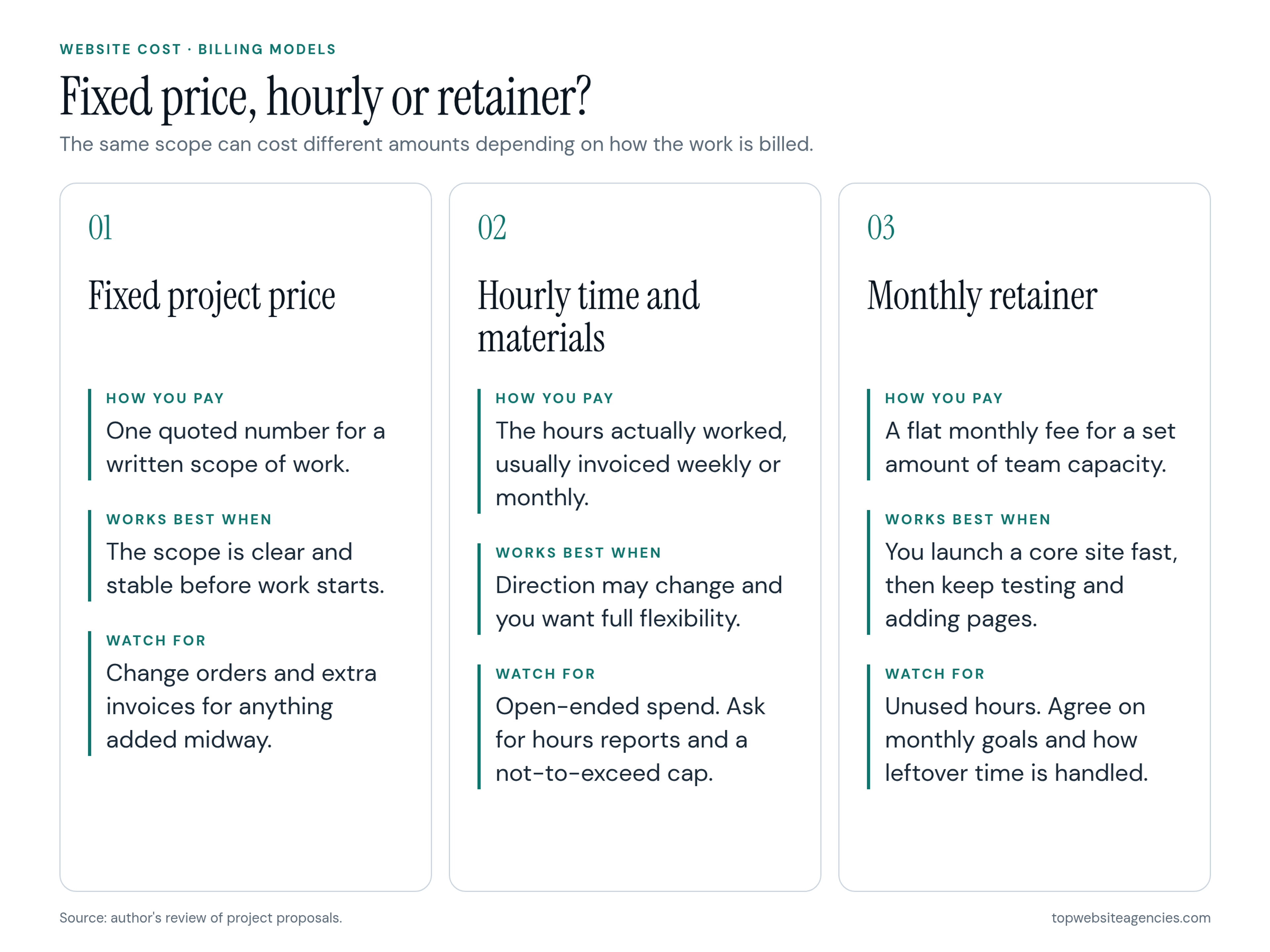
Fixed Project Price
The team quotes a single number for the whole project. This model needs a strict scope of work. If you ask for a new feature halfway through, you will receive a change order and an additional invoice. Fixed pricing gives you budget predictability but limits flexibility.
Hourly Time and Materials
You pay for the hours actually worked. This model offers full flexibility: you can change direction at any time. The trade-off is financial risk, because the project keeps consuming budget until you decide it is finished. Ask for a weekly hours report and a not-to-exceed cap.
Monthly Retainer
You pay a flat monthly fee for a set amount of capacity. This approach treats the website as a living product instead of a static brochure. The team launches a core site quickly and uses the remaining monthly hours to run tests, build new landing pages and improve conversion rates.
One-Time Build Costs vs. Ongoing Expenses
A website is never a one-time purchase. Budget for the infrastructure that keeps it live.
- The build cost: the one-time investment to design and develop the site.
- Hosting and CMS subscriptions: these scale with traffic and the number of sites. Kinsta's managed WordPress hosting plans, for example, start at $35 a month for a single site, while its enterprise plans start at $500 a month.
- Routine upgrades: CMS platforms release security patches and code libraries get deprecated. You will need a developer to keep the site secure and working over time. For realistic monthly figures by site size, see our line-by-line guide to post-launch upkeep budgets.
How Timeline and Team Size Affect Cost
Speed costs money. If you need a custom website designed and developed in four weeks instead of a more typical twelve, you will pay a rush premium. In the proposals I review, rush premiums of 25% to 50% are common, because the team has to clear its schedule, work longer hours and put several developers on the project at once.
Team size works the same way. A larger team finishes sooner but costs more per week, and every added specialist adds coordination time.
Hidden Expenses to Budget For
Founders routinely miss these expenses during initial budgeting:
- Commercial font licenses: Premium typography is rarely free. Web licenses are often priced by traffic and can cost hundreds of dollars a year.
- Video hosting: High-quality background or product videos need a dedicated hosting platform so they don't slow the site down.
- Stock photography and illustration: Licensed images and custom illustrations are often quoted separately from design.
- Legal pages: You need a privacy policy and terms of service, drafted by a lawyer or generated with a paid compliance tool.
Writing a Brief and Setting a Budget
Never hide your budget from prospective partners. Many business owners withhold it, hoping for a better deal. This strategy backfires.
If you ask for a car without stating a budget, one dealer quotes a used sedan and another quotes a custom sports car. Both are cars, and neither quote helps you make a decision. State a realistic range in your brief. A good partner will look at that range and tell you what is possible within it.
Worked Example: Budgeting a 20-Page Business Site
Here is a realistic scenario. A B2B technology company needs a new 20-page website with custom design, professional copywriting and an SEO migration from its old site. It hires a small US-based studio:
- Discovery and UX strategy: $4,000
- Custom visual design (8 unique templates): $12,000
- Webflow development and animations: $10,000
- Professional copywriting (5 core pages): $4,500
- SEO migration and redirect mapping: $2,500
- QA testing and launch: $2,000
The total build cost comes to $35,000. Ongoing costs include a CMS subscription, the domain renewal and a maintenance retainer for technical support.
Frequently Asked Questions (FAQ)
Why do agencies charge so much more than freelancers?
Agencies carry operational overhead. When you hire one, you pay for a project manager, a strategist, quality assurance testing and the stability of a company that will not disappear halfway through your build. You are buying risk reduction.
Can I get a custom website for under $5,000?
In the US market, it is unlikely. A $5,000 budget usually buys a customized template from a solo freelancer. True custom design needs dozens of hours of user experience planning and wireframing before development begins.
How much should a website redesign cost compared to a new build?
A redesign can cost as much as a new build, and sometimes more. Redesigns add content audits, 301 redirect mapping to protect rankings, and careful migration of existing content, user data and CRM integrations.
How much should I budget each year after launch?
Plan for hosting, licenses and developer time every year the site is live. The amount depends on the platform and the size of the site, so set it at the same time as the build budget instead of after launch.
Conclusion
Understanding the variables behind website cost is the best way to protect your budget. Whether you spend $10,000 or $100,000, the goal is to match the investment to what the website has to achieve for the business. Once you know your tier and your scope, write a brief with a clear budget range, then use the rankings on Top Website Agencies to shortlist teams, review their past work and start conversations with the ones that fit.