A realistic ecommerce website cost in the US runs from about $5,000 for a customized Shopify theme to $300,000 or more for a headless or fully custom build. The upfront quote is only part of the bill. Platform plans, payment processing, apps, and ongoing development usually add more over three years than the build itself, so a store quoted at $30,000 can easily cost $100,000 or more to own across 36 months.
I see this gap constantly as editor of the Top Website Agencies rankings, where I read proposals from the ecommerce web design agencies we have vetted. Two quotes for the same catalog can differ by $100,000, and the difference almost never comes down to one team being greedy. It comes down to architecture: which platform, how much custom design, and how many systems the store has to talk to.
Earlier, leading design teams at Copy.ai, Around, HackerRank, and AWS taught me to judge software by what it costs to run, not only what it costs to buy. The same logic applies to an online store. This guide breaks down what drives an ecommerce build quote, how the main Shopify and custom paths compare, what you pay every month after launch, and how to scope the project before you ask anyone for a number.
Ecommerce Website Cost at a Glance
In the proposals I review, US builds fall into three broad tiers:
- Entry-level build ($5,000 to $15,000): Shopify with a premium theme, configured sections, brand typography and minimal custom code. This fits early-stage direct-to-consumer brands with a simple catalog and under $1 million in annual sales.
- Mid-market build ($25,000 to $85,000): A custom design system on Shopify, Shopify Plus, or BigCommerce, with custom Liquid templates, one or two system integrations, checkout adjustments and conversion work. This usually serves brands between $1 million and $10 million in gross merchandise value (GMV).
- Enterprise build ($100,000 to $300,000+): Headless Shopify, Adobe Commerce, or a custom framework, with middleware, ERP integration, multiple regions and strict compliance requirements.
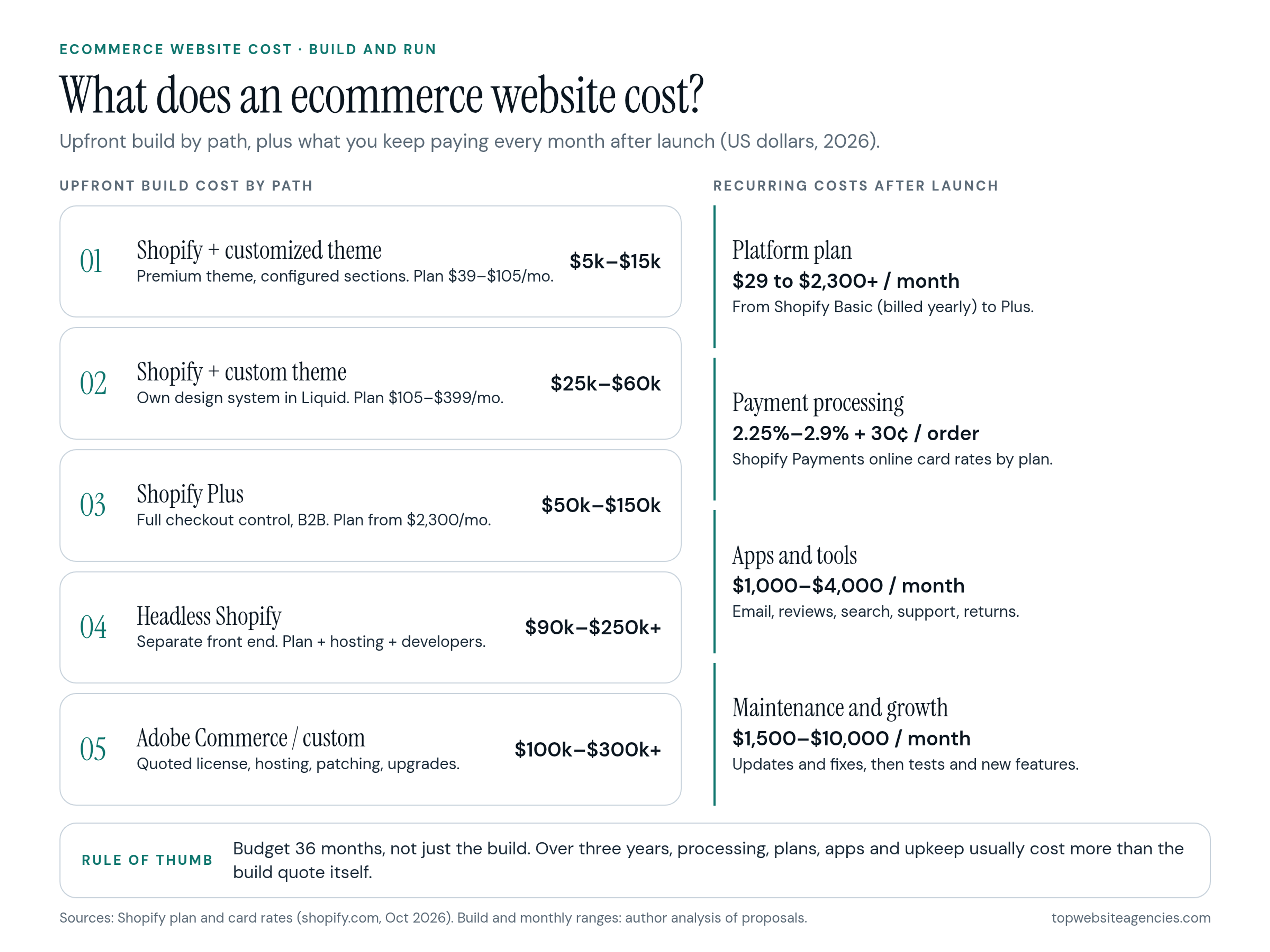
Which tier you land in depends less on how many products you sell and more on the six cost drivers below.
What Drives an Ecommerce Build Quote
Catalog complexity and filtering
A store selling 20 apparel items in three colors costs far less to build than one selling 5,000 industrial parts with 50 technical attributes each. Costs climb when product relationships need custom data structures, or when shoppers must filter across dependent attributes, for example choosing a vehicle year, make and model to see compatible parts. Native search often can't handle that, and adding a dedicated search and merchandising tool typically adds $5,000 to $15,000 in setup, plus a monthly subscription.
Theme customization vs a custom design system
A paid premium theme is a one-time purchase of a few hundred dollars. The real cost is the 40 to 80 hours a team spends configuring sections, matching your typography and setting up templates.
A bespoke design system is a different project. Designers map every state of the product page, cart drawer, mobile navigation and account area before front-end development starts, which usually means 150 to 350 design hours. In the quotes I've reviewed, that adds $20,000 to $50,000. You get differentiation and no template limits, but you pay for it upfront.
Systems integration depth
Integrations consume a large share of any custom budget. Typical ranges I see:
- ERP (NetSuite, SAP, Microsoft Dynamics 365): $15,000 to $45,000 per integration for real-time inventory, customer and order sync through middleware or direct API work.
- PIM (product information management): $8,000 to $20,000 to connect cleanly when product data lives outside the store.
- Tax and shipping: $2,000 to $6,000 for automated tax calculation and custom rate rules.
B2B and wholesale features
Customer-specific price lists, quick order forms, quantity breaks, net payment terms and approval workflows are where consumer and wholesale stores diverge. Shopify now lists B2B catalogs on every plan, capped at three below Plus and unlimited on Plus, but anything beyond those native features means custom development. Expect $15,000 to $40,000 on top of a standard quote for serious wholesale workflows.
Data and SEO migration
Replatforming an established store is where rankings get lost. A proper migration cleans product data, moves customer and order history, preserves image alt text and maps every legacy URL to a 301 redirect. That work usually adds $5,000 to $20,000. If you are moving an existing site, compare against cost ranges for redesigning an existing site so you can tell which part of the quote is the store and which is the migration.
Accessibility and performance
Keyboard navigation, screen reader support, color contrast and focus states have to be designed and built deliberately, and so does a fast mobile product page (a Largest Contentful Paint under 2.5 seconds is the usual target). Doing both properly tends to add 15% to 25% to front-end development. It is cheaper than retrofitting after launch.
Comparing the Main Build Paths
Your platform choice sets both the upfront quote and your operating costs for years.
Shopify with a customized theme
- Upfront build: $5,000 to $15,000
- Platform plan: Basic is $39 a month or $29 billed yearly; Grow is $105 a month or $79 billed yearly, according to Shopify's current plan and card-rate page.
- Timeline: about 4 to 8 weeks.
- Watch for: stacking dozens of apps to change a theme's core behavior. That slows the site and creates code conflicts.
Shopify with a fully custom theme
- Upfront build: $25,000 to $60,000
- Platform plan: Grow or Advanced; Advanced is $399 a month or $299 billed yearly.
- Timeline: about 12 to 16 weeks.
- Why it works: for most mid-market brands this is the sweet spot. You get a unique storefront and editor controls your marketing team can use, on a managed platform with no servers to patch.
Shopify Plus
- Upfront build: $50,000 to $150,000
- Platform plan: starts at $2,300 a month, with 1-year or 3-year terms.
- What you get: full checkout customization (other plans are limited), unlimited B2B catalogs, up to nine free expansion stores and up to 500% higher API call limits.
When does Shopify Plus pay for itself?
Merchants ask me this more than anything else, and the first-pass math is simple. With Shopify Payments, Advanced charges online card rates from 2.5% + 30¢ and Plus from 2.25% + 30¢. That is a 0.25-point difference. The plan difference is $2,001 a month ($2,300 minus $299 billed yearly). Divide $2,001 by 0.0025 and you get a breakeven of about $800,400 in monthly online card sales, or roughly $9.6 million a year. Below that, Plus has to earn its cost through checkout customization, B2B, expansion stores or automation.
The math shifts if you use a third-party payment provider: Shopify adds a transaction fee of 0.6% on Advanced and 0.2% on Plus, so the gap widens and Plus breaks even much sooner.
Headless Shopify
Headless splits the storefront (often built in React or Next.js) from Shopify's backend, which serves products, cart and checkout through the Storefront API.
- Upfront build: $90,000 to $250,000+
- Monthly cost: your Shopify plan plus front-end hosting and a developer retainer.
- Reality check: Shopify's own headless guidance says a headless storefront costs more to build and run than a theme, and that the merchant needs developers to maintain it after launch. Many brands go headless too early. Unless the experience truly can't be built with a theme, a custom Liquid theme delivers the same business results for a fraction of the cost.
BigCommerce
BigCommerce's 2026 plans tie price to sales volume. On its plan comparison page, the Scale plan is $299 a month billed annually for up to $33,333 in monthly GMV, with 0.9% charged on GMV above that cap, and Performance plans start at $1,499 a month billed annually. Builds typically run $30,000 to $100,000. It is a strong option for multi-storefront and hybrid B2B setups.
WooCommerce and Adobe Commerce
- WooCommerce: the software carries no monthly platform fee, as WooCommerce describes its open-source platform. Builds run about $15,000 to $50,000, but you pay instead for hosting, paid extensions, security updates and plugin maintenance. Technical debt builds faster than on a managed platform.
- Adobe Commerce: highly customizable and common in large legacy setups. License fees are quoted individually rather than published, builds start around $100,000 and often pass $300,000, and hosting, patching and upgrades add a heavy ongoing cost.
Recurring Costs After Launch
Most merchants budget for the build and underestimate the monthly bill. Four lines matter.
Platform plan
From $29 a month (Shopify Basic billed yearly) to $2,300 a month and up for Shopify Plus, or a quoted license plus hosting on Adobe Commerce.
Payment processing
Processing usually outgrows the platform fee quickly. Shopify Payments online card rates are 2.9% + 30¢ on Basic, 2.7% + 30¢ on Grow, 2.5% + 30¢ on Advanced and 2.25% + 30¢ on Plus. Third-party providers add Shopify's extra fee: 2% on Basic, 1% on Grow, 0.6% on Advanced and 0.2% on Plus. On $100,000 in monthly sales at a $100 average order value, Shopify Payments processing alone runs from about $2,550 to $3,200 a month.
Apps and tools
Email and SMS, reviews, subscriptions, search, support and returns tools add up. A scaling direct-to-consumer brand commonly spends $1,000 to $4,000 a month on apps.
Maintenance and development
- Maintenance retainer ($1,500 to $3,000 a month): platform and app updates, conflict fixes, accessibility checks and monitoring.
- Growth retainer ($4,000 to $10,000 a month): A/B tests, new features, campaign landing pages and conversion work.
A 3-Year Total Cost of Ownership Model
Comparing builds on the upfront quote alone is the most common budgeting mistake I see. Here is a simplified model for a brand doing $3 million a year ($250,000 a month) at a $100 average order value, which means 2,500 orders a month.
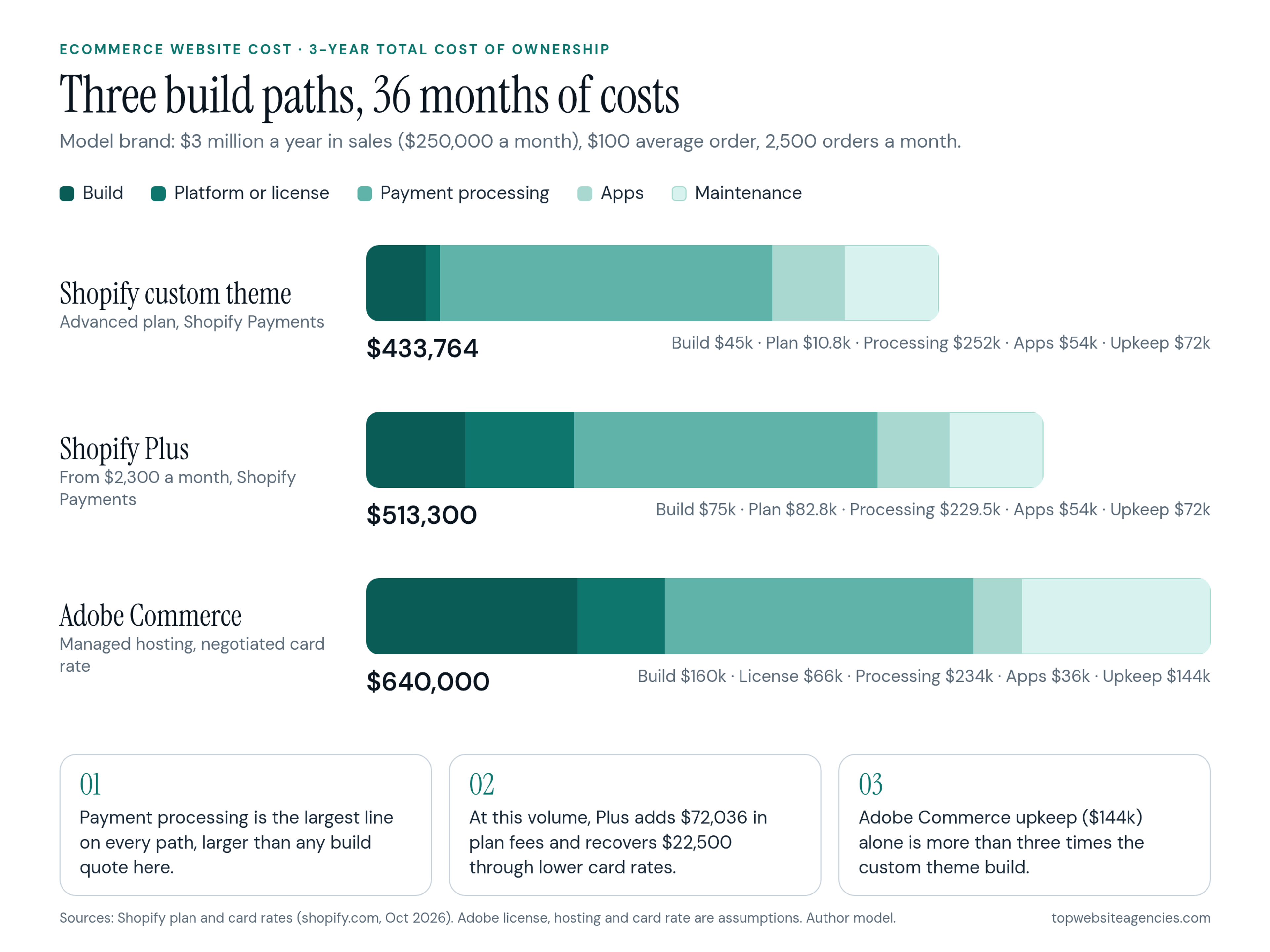
Approach A, Shopify custom theme on Advanced: about $433,764 over three years
- Build: $45,000
- Platform: $10,764 ($299 a month billed yearly)
- Processing: $252,000 (2.5% + 30¢)
- Apps: $54,000 ($1,500 a month)
- Maintenance: $72,000 ($2,000 a month)
Approach B, Shopify Plus: about $513,300 over three years
- Build: $75,000
- Platform: $82,800 ($2,300 a month)
- Processing: $229,500 (2.25% + 30¢)
- Apps: $54,000 ($1,500 a month)
- Maintenance: $72,000 ($2,000 a month)
Approach C, Adobe Commerce with managed hosting: about $640,000 over three years
- Build: $160,000
- License and hosting: $66,000 (an assumed $22,000 a year; get a real quote)
- Processing: $234,000 (an assumed negotiated 2.3% + 30¢; Stripe's standard rate is 2.9% + 30¢ for domestic cards, which would make this line $288,000)
- Apps: $36,000 ($1,000 a month)
- Maintenance: $144,000 ($4,000 a month for security patches, upgrades and hosting management)
Three things stand out. First, processing is the largest line on every path, so negotiating rates or reaching the next card-rate tier matters more than the build quote. Second, at $3 million a year, Plus costs $72,036 more in platform fees over three years and recovers only $22,500 through lower card rates; the rest has to come from checkout, B2B or international gains. Third, Adobe Commerce's maintenance premium alone can exceed the entire build budget for a Shopify custom theme.
How to Scope the Project Before You Ask for Quotes
The clearer your requirements, the closer the quotes will be to each other and to the final invoice. Before you send a brief, prepare:
- Current analytics: sessions, conversion rate, mobile vs desktop split and peak order volume.
- Catalog matrix: active SKUs, maximum variants per product, product options and custom fields.
- Integration list: every system the store must connect to (ERP, CRM, warehouse, email, tax, reviews) and whether it has a documented API.
- Must-have custom features: bundle builders, subscriptions, localized prices, B2B portals.
- Three reference sites: with notes on exactly what you like about each.
Put all of it in one document and ask every bidder to price the same scope. For a template and evaluation criteria, see how to structure an RFP so proposals are comparable.
Red Flags in Ecommerce Build Proposals
- A fixed quote under $15,000 that promises custom design and ERP sync. Real integration work costs more than that whole budget. You will likely get a modified template and a fragile data connection.
- Vague integration allowances. "Connect ERP" is not a scope. A proposal should name the endpoints, sync frequency and any middleware.
- No SEO migration line items. If there is no 301 redirect map, crawl comparison before and after launch, or structured data transfer, your rankings are at risk.
- No device and accessibility testing plan. Ask which devices, browsers and WCAG checks are included.
- No post-launch warranty. Professional teams usually include a 30 to 60-day bug-fix window. Be wary of contracts that move straight to a paid retainer on launch day.
How to Lower Cost Without Hurting Conversion
If quotes exceed your budget, cut technical complexity, not design quality or mobile usability.
- Use native features before apps. Check what the platform already does for markets, currencies, discounts and custom fields before paying for another app.
- Keep product options standard. Custom visual configurators often add $15,000 to $30,000 in front-end work. Use standard variants where you can.
- Phase integrations. Launch with the revenue essentials (catalog, cart, checkout, payments, email) and move loyalty, referrals and review syndication to a second phase paid for by sales.
- Start from a proven base. Building on a team's existing component library or a lightweight starter theme typically saves 40 to 60 hours of layout work, which you can spend on the parts of the brand customers actually notice.
Frequently Asked Questions (FAQ)
How much does an ecommerce website cost for a small business?
A small business on Shopify with a customized premium theme typically pays $5,000 to $15,000 for the build, plus $29 to $105 a month for the plan and card processing on every order. Apps add a few hundred dollars a month at this stage.
Does a headless Shopify build improve SEO?
It can, because you control page speed and rendering in detail. But you lose plug-and-play theme apps and need developers to maintain the storefront. For most brands, a well-optimized Shopify theme ranks just as well without the extra cost.
How much should I budget for ecommerce apps each month?
A scaling mid-market brand typically spends $1,000 to $4,000 a month on third-party apps for email and SMS, reviews, subscriptions, search and support. Early-stage stores often stay under $500.
Is WooCommerce cheaper than Shopify?
Upfront, often yes, because there is no platform subscription. Over three years the gap narrows or reverses once you add hosting, paid extensions, security updates and developer time. Compare total cost, not the license line.
Can I start with a theme and go custom later?
Yes. If cash is tight, spend on product and customer acquisition first. A customized premium theme can carry a brand to its first $1 million in sales, and you can invest in a custom design system in the next growth phase.
Conclusion
The build quote is the most visible number in an ecommerce project, but it is rarely the largest. Platform plans, processing, apps and maintenance decide what the store really costs, and catalog complexity, integrations and migration decide what the build costs. Model 36 months before you choose a path, scope integrations and SEO migration in writing, and ask every bidder to price the same brief. When you are ready to compare teams, our ranked list of ecommerce web design partners is a good place to start.